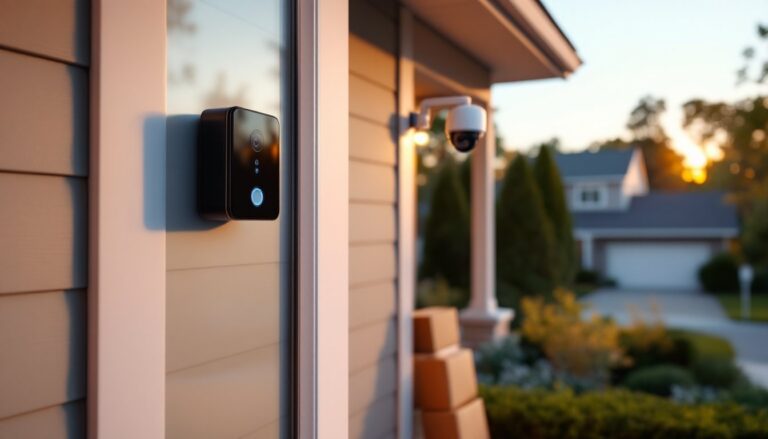
Most home break-ins happen under cover of darkness, when traditional cameras turn useless. IR security cameras solve that problem by using infrared technology to capture clear footage even when there’s zero visible light. Whether someone’s prowling around the back deck at 2 a.m. or a package thief targets the front porch after sunset, these cameras keep recording in conditions that would leave standard models blind. This guide walks through how IR cameras work, what features matter most, and how to install them for maximum coverage around a home.
Table of Contents
ToggleKey Takeaways
- IR security cameras use invisible infrared LEDs to capture clear footage in complete darkness, automatically switching from color day mode to black-and-white night mode based on ambient light levels.
- Mount IR security cameras 8–10 feet high at building corners with a 15–30 degree downward tilt to maximize facial recognition and perimeter coverage while preventing tampering.
- 4MP or 4K resolution combined with at least 20–30 fps frame rates ensures usable details for identification, especially when digitally zooming on license plates or facial features.
- Expect realistic IR range of one-third the manufacturer’s claim—a 100-foot rated camera typically provides clear facial recognition at 30–40 feet in optimal conditions.
- Combine local SD card storage with cloud backup for redundancy, ensuring footage remains accessible even if the IR camera is stolen or power is disrupted.
- Prioritize entry points like front doors, driveways, and basement windows, and avoid mounting IR cameras through glass to prevent image washout from light reflection.
What Is an IR Security Camera and How Does It Work?
An IR (infrared) security camera captures video in complete darkness using infrared LEDs arranged around the camera lens. These LEDs emit light in the 850nm to 940nm wavelength range, invisible to human eyes but visible to the camera’s image sensor. When ambient light drops below a set threshold, the camera’s photoresistor triggers the IR LEDs to illuminate the scene.
The image sensor converts reflected IR light into a monochrome (black-and-white) video feed. That’s why night footage from IR cameras lacks color, the sensor is reading infrared wavelengths, not the visible spectrum. Most consumer IR cameras switch automatically between day mode (full color) and night mode (IR black-and-white) based on available light.
Key components include:
- IR LEDs: Typically 6–48 LEDs depending on model and range requirements
- IR-cut filter: A mechanical shutter that moves out of the way at night to allow IR light to reach the sensor
- Image sensor: Usually CMOS, optimized for both visible and near-infrared light
- Photoresistor: Detects ambient light levels to trigger mode switching
Because IR illumination is invisible, cameras operate covertly at night without advertising their presence with visible light. The trade-off is that IR footage shows less detail than daylight color video, fine for identifying motion and general shapes, but facial recognition drops off as distance increases.
Key Benefits of Installing IR Security Cameras for Your Home
IR cameras deliver 24/7 surveillance capability without gaps in coverage. Standard cameras become nearly useless after sunset unless the area is well-lit, but IR models maintain visibility in pitch darkness. That continuity matters for properties with limited exterior lighting or areas where adding floodlights isn’t practical.
Another advantage: energy efficiency. IR LEDs draw far less power than keeping outdoor lights running all night. A typical IR camera consumes 5–12 watts during night mode, about the same as a single LED bulb. For battery-powered or solar cameras, that efficiency extends runtime significantly.
Many modern home security systems pair IR cameras with motion detection algorithms tuned for nighttime use, reducing false alerts from shadows or headlights. Advanced models with passive infrared (PIR) sensors detect heat signatures from people and animals, improving detection accuracy over simple pixel-change motion detection.
IR cameras also provide better evidence quality in low-light conditions compared to cameras relying solely on ambient street lamps or porch lights. Consistent IR illumination reduces video noise and motion blur, making it easier to distinguish details like clothing patterns or vehicle characteristics. Police departments report higher usability rates for footage from IR-equipped cameras compared to poorly lit color video.
Types of IR Security Cameras: Indoor vs. Outdoor Options
Indoor IR cameras typically feature compact housings, shorter IR ranges (20–40 feet), and emphasis on wide-angle lenses to cover rooms. They often include two-way audio and pan-tilt-zoom (PTZ) functions. Since they don’t face weather exposure, indoor models skip ruggedized enclosures and focus on blending into interior decor. Expect IP20 or IP30 ratings, enough dust protection, but zero water resistance.
Common indoor applications:
- Nurseries and kids’ rooms (night check-ins without turning on lights)
- Basements and garages (areas with limited natural light)
- Stairwells and hallways (monitoring movement paths)
Outdoor IR cameras need weatherproof housings rated IP65 or higher (dust-tight and protected against water jets). Many include IR ranges of 60–150 feet to cover driveways, yards, and perimeters. Housing materials, typically aluminum or impact-resistant polycarbonate, protect against temperature swings, UV exposure, and physical tampering.
Outdoor models often include:
- Varifocal lenses: Adjustable focal length (2.8–12mm range is common) to dial in the coverage area
- Heaters and fans: Maintain operating temps in extreme climates (-4°F to 122°F typical range)
- Vandal-resistant enclosures: IK10 impact rating withstands 55 joules of force (equivalent to a 5kg mass dropped from 1 meter)
Both categories now include wired (Power over Ethernet) and wireless (Wi-Fi with battery or solar) options. POE cameras deliver more reliable performance for critical locations, while wireless models simplify installation in spots where running cable isn’t feasible.
Essential Features to Look for When Choosing an IR Camera
Resolution matters, even at night. 1080p (1920×1080) is the minimum for usable detail: 4MP (2560×1440) or 4K (3840×2160) models provide clearer identification at distance. Higher resolution helps when digitally zooming during footage review, a common need when trying to read a license plate or distinguish facial features.
Frame rate impacts motion clarity. Look for cameras that maintain at least 15 fps in IR mode: 20–30 fps is better for capturing fast movement without excessive blur. Some budget models drop to 10 fps at night, which creates choppy, less useful footage.
Smart detection features reduce alert fatigue. AI-powered person/vehicle/animal detection filters out non-threatening motion like swaying branches or passing cars. Some cameras now include facial recognition and package detection, though these features typically require cloud subscription services.
Storage options matter for retention and access. Choices include:
- Local SD card: 64–256GB typical, 7–30 days retention depending on resolution and activity
- NVR (Network Video Recorder): Wired system with dedicated recording hardware, often 1–4TB capacity
- Cloud storage: Subscription-based, 7–60 day retention, accessible from anywhere
Several home security cameras now offer dual recording (local + cloud) for redundancy. If someone steals the camera or cuts power, cloud footage remains accessible.
Audio capability adds context. Two-way audio lets homeowners speak through the camera, useful for greeting delivery drivers or deterring trespassers. Quality varies widely: look for cameras with noise cancellation and at least 80dB speaker output for effective outdoor communication.
IR Range and Night Vision Distance
IR range specifies how far the camera illuminates and captures usable footage in complete darkness. Manufacturers’ claims often overstate real-world performance. A camera rated for 100 feet typically provides clear facial recognition at 30–40 feet and general shape identification out to 70–80 feet.
Factors affecting actual IR range:
- LED count and power: More LEDs and higher wattage extend range but increase power draw and heat
- Lens focal length: Narrow (telephoto) lenses concentrate IR light for longer range: wide-angle lenses spread it thin
- Atmospheric conditions: Fog, rain, and snow scatter IR light, reducing effective range by 30–50%
- Reflective surfaces: Glass, metal, and water can create glare hotspots that wash out the image
Some advanced cameras use IR illuminators with adjustable beam angles, narrow for distance, wide for close coverage. According to testing by tech reviewers at CNET, the effective range for identifying a person’s face in optimal conditions is roughly one-third of the manufacturer’s stated IR range.
For large properties, consider cameras with 850nm LEDs (visible red glow but longer range) for perimeter monitoring and 940nm LEDs (completely invisible but shorter range) for covert surveillance near entry points. Combining multiple cameras with overlapping coverage provides better results than relying on a single long-range unit.
Best Placement Tips for Maximum IR Camera Coverage
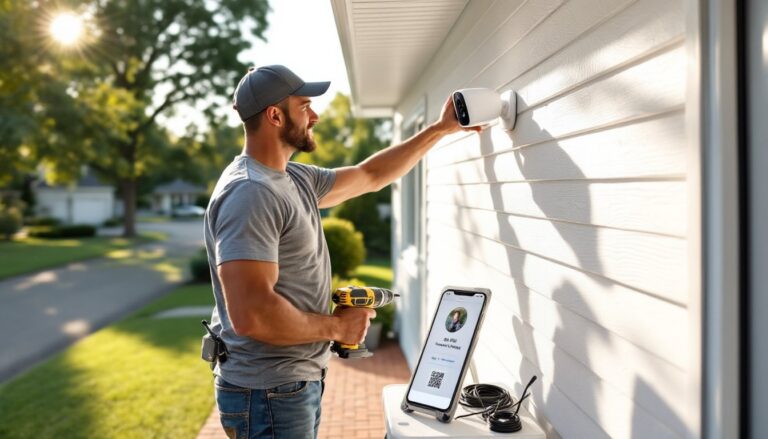
Mount outdoor cameras 8–10 feet high, high enough to prevent tampering but low enough to capture facial details. Tilting the camera down at a 15–30 degree angle provides the best balance between facial recognition and coverage area. Avoid mounting directly overhead: steep downward angles capture the tops of heads, which doesn’t help with identification.
Corner placement maximizes coverage. A camera positioned at a building corner can monitor two walls simultaneously. For rectangular properties, four corner-mounted cameras often provide near-complete perimeter coverage.
Key areas to prioritize:
- Front door and main entries: 80% of burglars enter through front, back, or garage doors
- Driveway: Captures vehicles and anyone approaching from the street
- Back and side yards: Secondary entry points and equipment storage areas
- Basement windows: Ground-level access points often overlooked
Avoid pointing IR cameras through glass. The IR light reflects off the window surface, creating glare that whites out the image. If indoor monitoring of outdoor areas is necessary, disable the IR LEDs and rely on exterior lighting, or mount the camera outside.
IR reflection management prevents image washout. Keep cameras at least 3 feet away from walls, fences, or other surfaces that can reflect IR light back into the lens. When mounting under eaves, ensure the mounting surface is dark-colored or textured to reduce reflection. Some installers paint the underside of eaves with flat black paint to minimize glare.
When using wireless security cameras, verify Wi-Fi signal strength at the installation location before permanently mounting. A camera with a weak connection will drop frames and delay alerts. Wi-Fi range extenders or mesh networks solve connectivity issues for distant mounting locations.
For wired cameras, run Cat5e or Cat6 cable through conduit when crossing exposed areas. Protect connections with weatherproof junction boxes. If running cable through walls, maintain at least 6 inches separation from electrical wiring to prevent interference (NEC Article 800 recommends this for low-voltage communication cables, though it’s not always strictly enforced for residential installations, check local codes).
Test camera placement before final mounting. Use temporary mounts or have a helper hold the camera while checking the live view. Adjust height, angle, and lens zoom to dial in the optimal field of view. Walk through the coverage area to identify blind spots, especially near corners and recessed entries where angled walls can block the camera’s line of sight.
Conclusion
IR security cameras eliminate the blind spots that occur when the sun goes down, providing continuous surveillance without the cost of running exterior lights all night. Choosing the right model depends on coverage needs, mounting location, and integration with existing security systems. With proper placement and realistic expectations about IR range, these cameras deliver reliable night vision protection for any home.